


Since 1982, Kimlin Energy has been working with local businesses to meet their fuel services needs.
One of our most popular commercial offerings is providing temporary heat services. It can get frigid here in the Hudson Valley. The average low temperature in January is 10˚ F, and it can get much colder, with the record low being –30˚F!
But work needs to get done even when the temperature plummets. That’s why Kimlin Energy is the choice for so many local construction companies and other businesses when it comes to temporary heating services.
We deliver commercial fuel across seven Hudson Valley counties: Ulster, Dutchess, Orange, Putnam, Westchester, Greene and Columbia.
Ulster and Dutchess are our core territory. Trucks run there every day, and we have been fueling businesses in both counties since 1982.
Orange, Putnam, Greene and Columbia are regular routes. We are in each of them once or twice a week, and we add trucks as demand builds.
Westchester runs on the same basis, though we are based north of the county, so we are not the closest option for every address. We will tell you plainly on the phone whether yours works for us.
We take work outside those seven counties as well, Albany County among them, when the job fits. Ask us.
We would rather name the limits than claim the whole valley and disappoint a job site in January.
You need to finish your construction, remodeling and renovation projects to earn income. Deadlines don’t care about weather.
Temporary heat services from Kimlin Energy help you keep your projects moving forward. Here’s how temporary heating works for you:
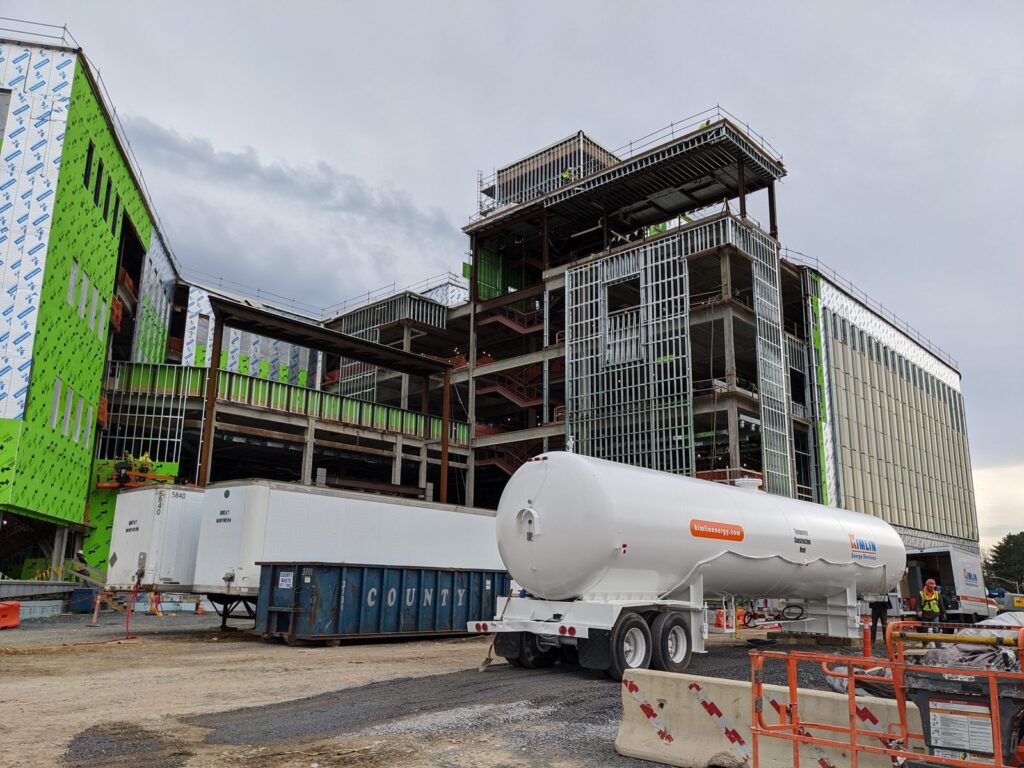
UAbany ETECH Temporary construction heat at a commercial build in Albany County. The tank, the regulators and the fuel all come from us.
In the coldest stretches, some sites need a fill every two or three days, and we run that schedule. That is the part most suppliers cannot hold. Temporary heat is not one delivery, it is a delivery cadence that has to survive January.
We run more than 20 trucks with backup drivers and night drivers, so the schedule does not depend on one person being available. When a site needs a second fill in a week, it gets one.
We also plan around storms. When snow is forecast, we top off temporary heat sites before it arrives rather than trying to reach them afterward. A job site that runs dry during a storm loses more than a day.
We keep hundreds of job sites running across the Hudson Valley, from single-building renovations to multi-story commercial construction. Recent work includes temporary heat through the restoration of Mirbeau Inn and Spa in Beacon. We will put you in touch with contractors on sites like yours. Ask us for references before you commit, and ask the same of anyone else you are considering.
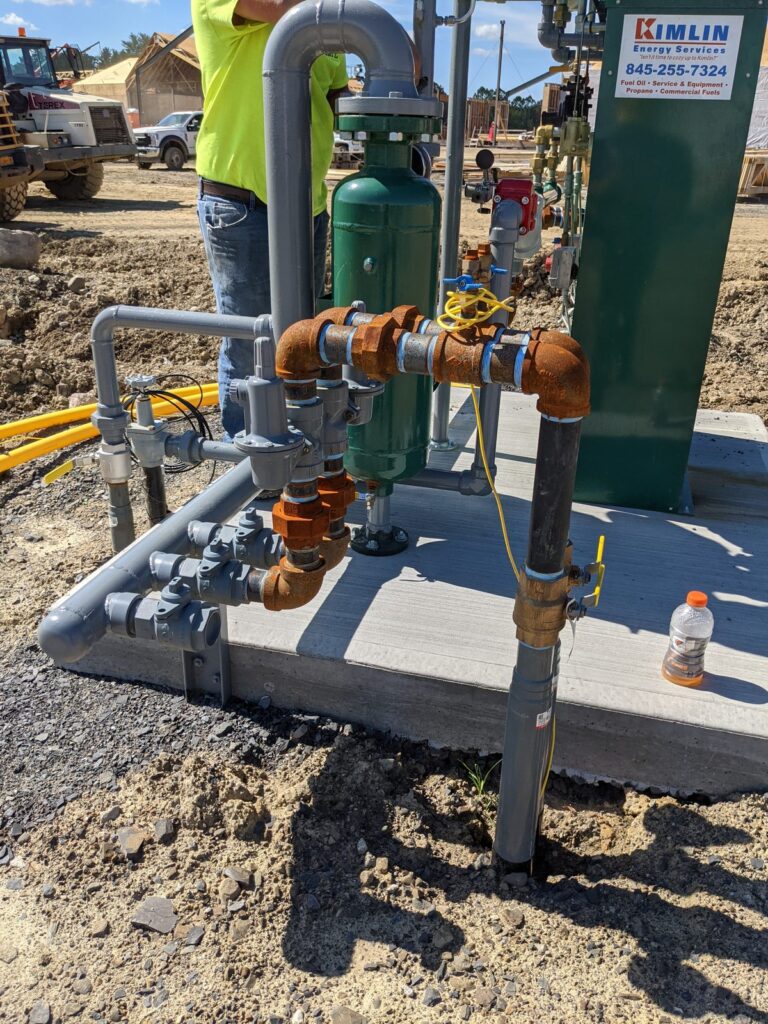
Vaporizer and regulator train set on a poured pad. Temporary heat is a gas system, not just a fuel drop.
Kimlin Energy provides everything you need to set up temporary heating at your job sites. We have the heaters, lines, hoses, regulators and, most important, our premium fuel! We offer on-call and next-day service, so you know you’ll always have everything you need to keep your job sites warm and safe. Our temporary heat services are customized to meet your business’s needs.
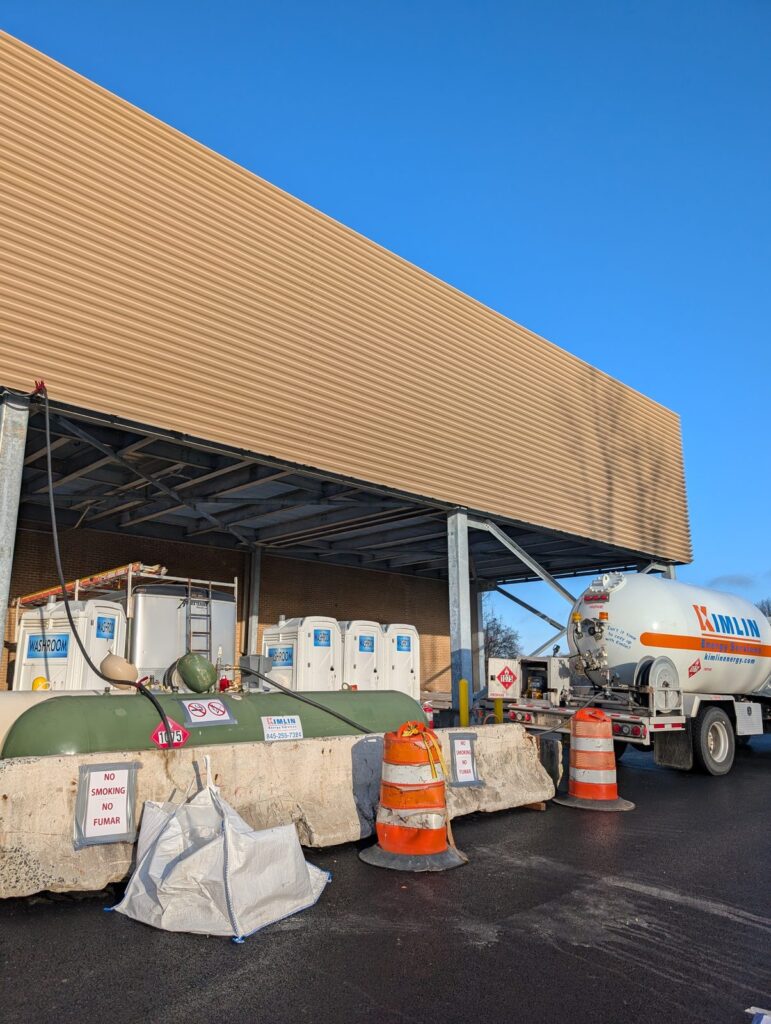
A Westchester County job site running on Kimlin temporary heat through the winter.
Both, and which one you want depends on the job. Anyone who answers this question with a single product is selling you what they have on the yard rather than what your site needs.
Direct-fired heaters put combustion products into the space along with the heat. They are efficient and they move a lot of BTUs, but they add moisture and they need real ventilation. They suit open framing, thaw work, slab curing and early-stage conditions.
Indirect-fired heaters burn outside the space and push clean, dry heat in through a heat exchanger, venting exhaust outdoors. That is what finishing work needs. Drywall mud, paint, flooring, millwork and anything moisture-sensitive should be run on indirect heat.
Most jobs use both at different stages. We will tell you which one your phase calls for, and we will say so even when it is the cheaper answer.
We have a rep dedicated to temporary heat who works with contractors directly. Not a call center and not whoever picks up. He will size the job with you, work out tank placement and heater count, and stay reachable by phone or text while the job runs.
Bring him the plans, the schedule and the enclosure details and he will build the setup around them. If the schedule moves, and it always does, you text him.
Yes. Tank monitoring is available on every commercial account we serve, including temporary heat. The monitor reports the level to us directly, so we schedule the refill against what is actually in the tank rather than against a guess about how hard you ran the heaters last week.
On a winter build that is the difference between a scheduled fill and a stopped job.

Temporary heat through the restoration of Mirbeau Inn and Spa in Beacon, Dutchess County.
We quote equipment, fuel and delivery as separate lines, in writing, before the job starts. You see the propane price per gallon, the equipment charge, the delivery fee and any after-hours rate on their own, rather than bundled into one number you cannot check.
Every fee we charge is published, with dollar amounts. On a winter build the fees are where the surprises live, and you should be able to see all of them before you sign anything. As far as we know, we are the only fuel dealer in the Hudson Valley that publishes a full schedule.
Contact us to learn more about our temporary heat services!